Geopolitics
Hacking Venezuela's Elections

There I was, watching what’s going on in Venezuela with this 2024 vote, its results and the statements that followed, and I found myself intrigued by all the talk of an attempted “hack” of the country’s electoral system.
Señor Nicolás Maduro Moros spoke openly about this attempted mass hack by a country they already knew, and I quote: “A massive hack of the National Electoral Council’s transmission system, because the demons didn’t want the count to be totalled and the official bulletin to be issued”.
Right then, what system are they actually using to count the tally sheets?
The Bolivarian Republic of Venezuela first introduced electronic voting back in 1998, in an initial phase.
That first phase was a hybrid system: you marked your candidate on paper, and the paper was then scanned and sent to the central server.
For this project they had help from our very own homegrown company Indra Group and its papervote solution.
Here come the first inconsistencies, because Indra says it was there from 1998 to 2000, while Venezuela’s National Electoral Council (CNE) says nothing about any changes until 2003. But hey, who hasn’t padded their CV a bit to make the dates line up?
Oh, and don’t bother going to the CNE’s URL, because it’s “down”. I’d urge you to visit the archive.org version instead.
In 2003 they set about changing the electronic voting system, and so began a love affair with Smartmatic that lasted until 2017.
A consortium was formed between this company, which would supply its e-voting technology; Bizta, which would handle the counting at polling stations still using paper (which, as far as I can tell, means copying the papervote of our friends at Indra); and the state telecoms operator CANTV.
Some non-technical curiosities at this point:
I found very little on Bizta Corporation, except that Smartmatic’s current head of Technology held the same position at that company until 2004, and graduated from Simón Bolívar University in Caracas; there’s another former employee of both companies from that period who was also a university classmate of the CTO.
But there you go, my big discovery turned out to be a damp squib, because as far back as 2006 a New York Times article was already hinting at it, reporting that the US federal government was looking into Smartmatic’s purchase of Sequoia Voting Systems and, while it was at it, whether the company had links to the government of Señor Hugo Rafael Chávez Frías.
Acquisitions and purchases aside, time marches on and in 2017 the romance between Smartmatic and Venezuela comes to an end.
With an “expropriate it!”, so the story goes, the Venezuelan government kept the company’s machines and software, and that was the last anyone saw of them. See you later, alligator!
The CNE’s information doesn’t give any more details, but we need to know what happened to those machines, don’t we?
Well, the hot potato landed with the company that had developed Venezuela’s biometric verification system in 2011: ExClé.
ExCle is an Argentine company specialising in biometric systems, with an office in Caracas since 2004.
Under suspicion of helping to rig the 2017 elections, this subsidiary was sanctioned by the US Office of Foreign Assets Control for interfering in the 2020 elections.
In theory this company was supposed to use the machines Smartmatic had supplied at the time for the voting system, but I haven’t managed to find out whether they did, although there are rumours that they had to use other, new machines.
Right, let’s see: who can hack these machines for now? Whoever has physical access to them…
But they have to connect to something somewhere, and as we said above, that’s down to the National Telecommunications Operator, CANTV.
What do we know about this? Well, I quote the CNE verbatim:
“Likewise, data transmission takes place over secure, private networks provided by CANTV.”
and
“[…] to guarantee that the network used by the CNE is exclusive, completely isolated from the Internet and shielded against intruders. […]”
I’d like to think they used MPLS to interconnect all the polling stations with the counting centre, but come on, let’s assume they used VPNs to a concentrator that isn’t highly available, which is cheaper, easier and fun for all the family.
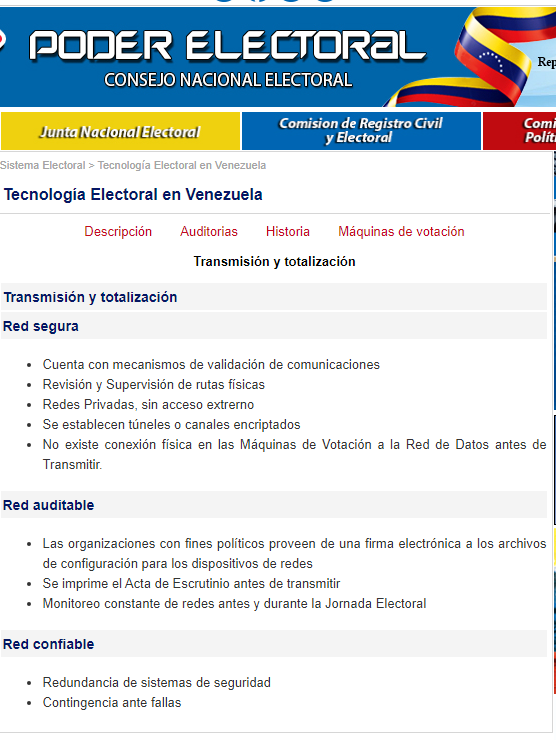
Features of the Data Transmission Architecture according to the CNE
The communications are encrypted, so we can’t “un-hack” that. The way we’d tamper with the data would be to find out the IP address of the counting centre and try to sneak in there…
Anyway, on 16 July the CNE’s head of Cybersecurity said:
“This network will be completely isolated; we will have no communication with the outside world; on the day of the event, the CANTV network will be assigned solely for this use", the technician explained. On the possibility of hackers getting into the CNE’s computer systems, he said that the probability of an external element gaining access “is remotely probable”, adding that the relevant tests had already been carried out and had shown that certain security details still needed to be resolved.”
You can read it on the website of the PSUV, Nicolás Maduro’s own party…

Cybersecurity news item on the PSUV website
I don’t know, Rick…
But hang on, are these people talking about the number of votes being changed in this hack?
I quote the Attorney General, Tarek Williams Saab:
“They wanted to tamper with the voting tally sheets of the automated system themselves”
“an attack that slowed down the sending of tally sheets for the count”
OK, OK… Hang on… He’s talking about a denial-of-service attack, which made the data take longer to send.
Well, look, in a network architecture with the VPN concentrator in the middle, I won’t say it couldn’t happen. I’ll buy that; it might well take longer. Why on earth didn’t you use the MPLS, for crying out loud?
What’s more, you’re the country’s telecoms provider: block anything that looks even remotely risky with BGP!
But come on, do you really think the data gets tired of waiting and then, just like that, one candidate’s votes vanish? Mate, that’s not how computers work.
My understanding is that the voting machines store the data inside them and transmit it when they can, and that’s that.
What kind of crass ignorance does it take to say that because something runs slower, it’s going to get altered?
All in all, how easy it is for everyone to blame a computer glitch or a cyberattack. It seems we tech people are always, always the ones to blame when something weird happens.
My view: no hack, no hacker, no nothing. We’ll see what explanations they give North Macedonia for this public accusation.
As I see it, and digging back through the archives a bit, it’s far easier for whoever owns the machines, the network and the servers to cheat on the final counts…
Thanks for reading, and sorry for the wall of text.
Originally published on LinkedIn on 31 July 2024.
Topics